Architectural Analysis of Louis Kahn's Hurva Synogogue
In the initial draft, Louis Kahn determined a slight rotation of the building axis. The building is not parallel to any boundary of its site; instead, it faces historical elements to honor the Temple Mount and the Western Wall. Rather than centering on site boundaries, the design centers on a broader urban environment and older symbolic meaning, reflecting Kahn’s macro-vision as a member of the Jerusalem Urban Environment Committee, emphasizing larger-scale urban contexts and more significant urban elements.
Louis Kahn treats space as an independent, discrete unit, whereby a building comprises multiple sub-units that remain separate from each other. Nevertheless, because they are interconnected in terms of function, circulation, and architectural form, spatial continuity is not lost.
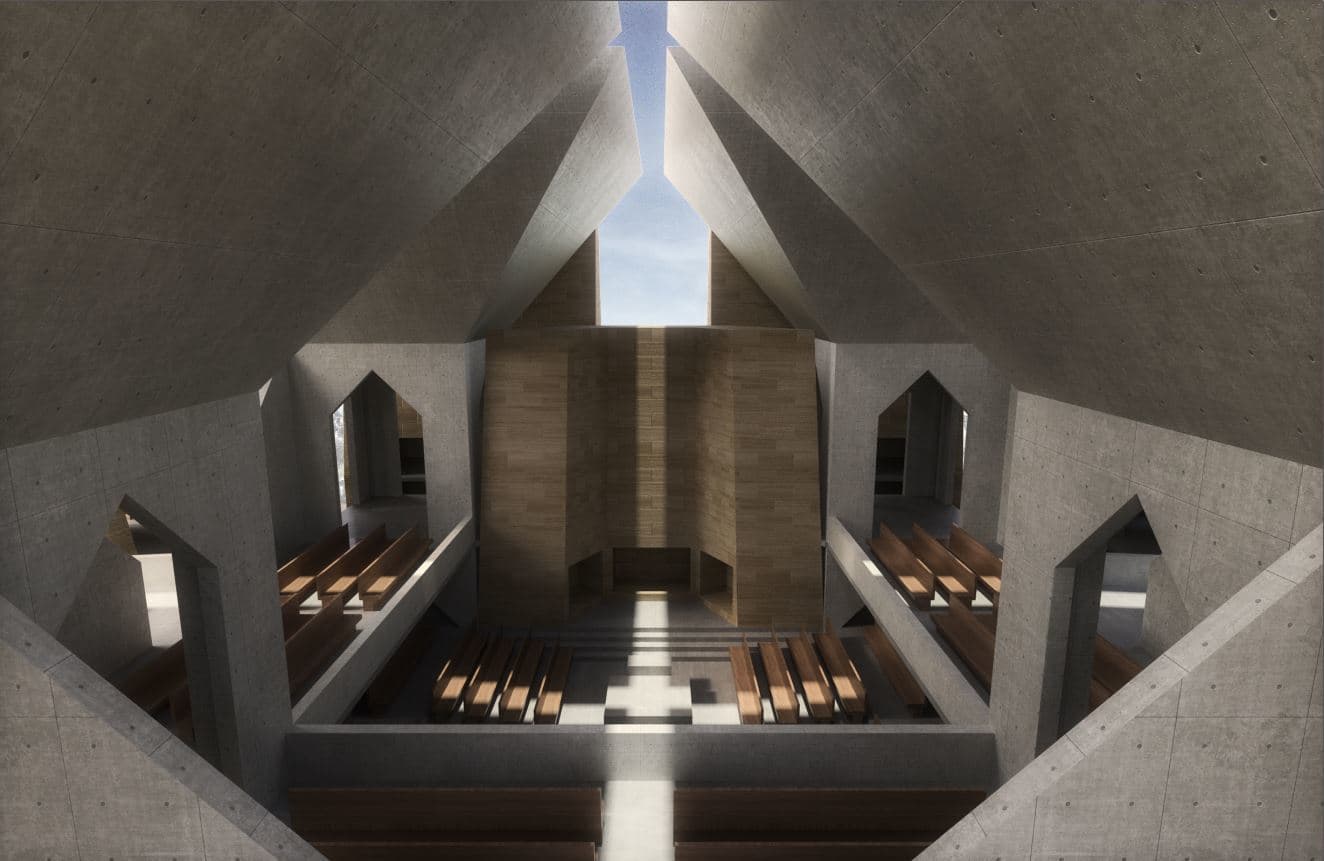
His projects also consistently employ natural light. By varying spatial configurations, different fenestrations, and diverse materials, he creates distinct perceptions of light and space, forming a variety of ambient experiences.
Section 3: Functional Zoning & Spatial Organization Logic
- Problem-oriented analysis
- Ritual purification process: cleansing the body—while reciting appropriate prayers and benedictions—followed by the pouring of a prescribed amount of water over the deceased.
- Rationale for constructing a Jewish funeral hall on the Mount of Olives: the site contains numerous Jewish cemeteries and is a holy place for Jewish people. From a religious perspective, building a Jewish funeral hall here is timely; practically, it facilitates daily life in contemporary society; economically, it aligns with agglomeration benefits.
- Geographic characteristics of a Jewish funeral hall on the Mount of Olives: summers are hot and dry, winters are humid and rainy, with an annual precipitation of nearly 590 mm.
- Objectives of the Jewish funeral hall: in light of Jewish beliefs about life, death, and a strong emphasis on present-world concerns—such as atonement and the pursuit of happiness in this lifetime—the proposed goal of the Jewish funeral hall is to express prayers for the deceased and to support the living in continuing to uphold their faith and lead virtuous lives in this world, thereby receiving blessing.